How AI Is Reshaping Private Lending (Canada)
August 18, 20269 min read

Updated August 2026
Private lending has always relied on fast judgment. The challenge is that judgment often sits behind a slow operating process.
Before a lender can make a decision, the team has to collect documents, check borrower details, review collateral, compare terms, confirm conditions, track approvals, and keep the file ready for funding or servicing. The more manual the work is, the more time the team spends preparing the decision instead of making it.
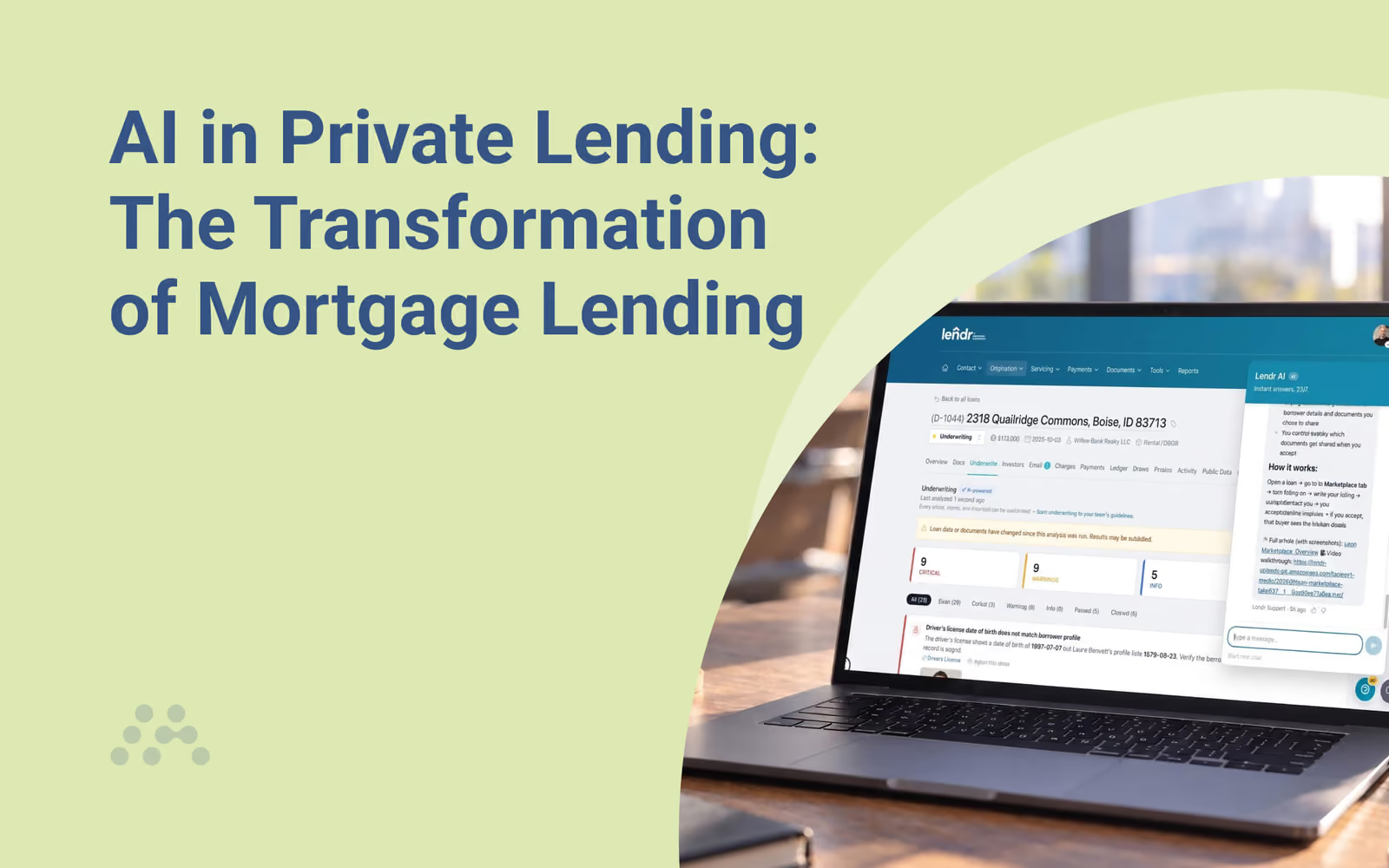
That is where AI is starting to change private lending. It can help organize borrower data, read documents, flag missing information, surface risk signals, and keep routine workflow steps moving. The lender still owns the call, but the file can reach that decision point with fewer administrative delays.
AI-Powered Underwriting and Risk Assessment
Underwriting is one of the clearest areas where AI in mortgage lending can support private lenders. Every file brings together borrower information, income or business records, property details, valuation inputs, loan purpose, repayment strategy, collateral risk, and supporting documents. Reviewing that information manually takes time, especially when the deal has missing items or unusual terms.
AI underwriting can help by scanning and structuring data earlier in the process. It can support:
- Automated data analysis: extracting useful information from applications, documents, financial records, and borrower submissions.
- Property valuation support: helping teams compare property details, market indicators, collateral data, and valuation inputs.
- Risk scoring: identifying factors that may need closer review before a file moves forward.
- Income and document verification: checking whether submitted information is complete, consistent, and ready for underwriting review.
- Fraud detection: flagging mismatched details, unusual patterns, duplicate information, or documents that require closer inspection.
- Faster prequalification: helping teams identify which files look ready for review and which need more information.
- Decision support: giving underwriters a stronger starting point without removing their judgment from the process.
For private lenders, AI risk assessment is most useful when it helps underwriters see the file more clearly. A late-stage surprise can slow the deal, change the structure, or create risk that should have been reviewed earlier. AI can help surface those signals sooner.
The lender still owns the decision. AI can highlight patterns, inconsistencies, and missing information, but underwriting depends on context: borrower history, collateral strength, exit strategy, market conditions, investor appetite, and internal credit policy.
Where AI Delivers the Most Value for Private Lenders
AI delivers the most value when it is tied to specific lending workflows. Broad promises about “smarter lending” do not help much unless the technology reduces a real source of operational drag.
Useful AI lending automation often shows up in these areas:
- Lead qualification: sorting inquiries, identifying incomplete applications, and helping teams focus on higher-fit opportunities.
- Loan origination: supporting intake, task routing, borrower follow-up, document requests, and approval steps.
- Document processing: reading submitted files, identifying missing documents, extracting key fields, and keeping records organized.
- Borrower communication: supporting status updates, reminders, document requests, and portal activity.
- Compliance monitoring: helping teams track required steps, missing records, audit trails, and review activity.
- Portfolio analysis: surfacing trends across active loans, payment activity, maturities, renewals, and exposure.
- Loan servicing: supporting payment workflows, borrower updates, statement activity, extensions, and servicing exceptions.
- Reporting automation: reducing the time spent rebuilding pipeline, servicing, investor, or operational reports from multiple sources.
AI works best when it complements lending workflow automation. The system should help route the file, organize the information, preserve the record, and show the team what needs attention.
AI and Compliance Automation
Compliance work creates pressure because every lending decision leaves a record. Private lenders need to know which documents were collected, which steps were completed, who approved the file, what changed during the process, and whether required checks were handled at the right time.
AI compliance tools can help teams manage that record with more consistency.
Examples include:
- identifying missing documents before a file advances
- checking whether required fields are complete
- flagging inconsistencies across borrower information and submitted documents
- organizing audit trails around approvals, tasks, and document updates
- supporting KYC, AML, and borrower verification workflows
- helping staff find relevant records faster during review
- monitoring files for incomplete compliance steps
AI document automation can be especially useful here. When the system can read, classify, and extract information from submitted documents, the team spends less time manually sorting files and more time reviewing the items that need judgment.
What AI Cannot Replace
AI has clear value in private lending, but it cannot carry the relationship, judgment, and strategic context behind the business.
Human expertise is still essential in areas such as:
- Relationship management: Borrowers, brokers, investors, and referral partners still rely on trust, communication, and commercial judgment.
- Complex underwriting decisions: Unusual collateral, layered borrower structures, market-specific risk, and exception-based lending require experienced review.
- Exception handling: AI can flag an issue, but people decide how to structure the response.
- Regulatory judgment: Compliance support tools can help identify gaps, but lenders need accountable oversight.
- Investor relationships: Reporting can be automated, but investor confidence still depends on communication and credibility.
- Strategic business decisions: Product mix, risk appetite, market focus, pricing, capital allocation, and growth plans require leadership judgment.
This balance is important. AI-powered lending should support the people who understand the borrower, the collateral, the market, and the lender’s risk appetite. A lender that treats AI as a replacement for judgment creates a different kind of risk.
Private lenders should evaluate AI lending automation by asking practical questions:
- Does it reduce manual work around the file?
- Does it improve visibility into risk?
- Does it keep records more organized?
- Does it help staff act sooner?
- Does it give underwriters better information without hiding the reasoning?
- Does it fit the lender’s workflow, loan types, and compliance needs?
If the answer is unclear, the tool may create more confusion than value.
How Mortgage Automator Uses AI to Improve Lending Operations
Mortgage Automator applies AI and automation to the operational work that slows lending teams down: document handling, task movement, file organization, compliance steps, reporting, and servicing handoffs.
Instead of asking teams to manage every update manually, Mortgage Automator helps keep loan activity organized around the file so staff can see what needs attention and move work forward with fewer disconnected steps.
The platform supports this through:
- Workflow automation: helping files move through defined steps with clearer task ownership.
- Intelligent document processing: supporting faster document handling, review, and organization.
- Automated task management: helping teams track what needs to happen next across origination, servicing, compliance, and reporting.
- Centralized loan records: keeping borrower details, documents, approvals, communication, and loan history tied to the file.
- Compliance support: helping teams manage required steps, audit trails, document records, and review activity.
- Reporting automation: improving visibility into pipeline activity, servicing work, and portfolio performance.
- Faster loan processing: reducing repeated manual work around intake, documents, approvals, and handoffs.
The value comes from the way AI and automation fit into the broader lending workflow. A document update should affect the file. A missing condition should create a follow-up. A completed approval should move the loan forward. A funded deal should carry accurate records into servicing.
Mortgage Automator is built for private lenders that need connected lending operations, not scattered tools around each step. Teams can manage origination, servicing, fund management, reporting, and automation from one platform.
Preparing Your Lending Business for AI
AI adoption works better when the lending operation is ready for it. A team with scattered data, inconsistent workflows, and unclear ownership will struggle to get value from any AI tool.
Start with the basics:
- Centralize loan data: Keep borrower information, documents, approvals, servicing records, and reporting inputs tied to the loan.
- Standardize workflows: Define how files move from intake to underwriting, approval, funding, servicing, and reporting.
- Automate repetitive processes first: Focus on document requests, task routing, reminders, reporting, and record updates before moving into more advanced AI use cases.
- Choose scalable lending software: AI should sit inside a system that can support origination, servicing, compliance, reporting, and integrations.
- Train teams alongside the technology: Staff need to understand what the system handles, what it flags, and when human review is required.
- Measure operational improvements: Track processing time, document turnaround, task completion, approval timelines, servicing workload, reporting time, and exception volume.
Private lenders should also review how AI tools handle transparency. If a system flags risk, the team needs to understand why. If it extracts data, staff need a way to review it. If it supports compliance, records need to remain accessible.
AI in private lending works best when the lending business has clean data, defined workflows, and people who know how to use the technology inside daily operations.
Frequently Asked Questions
How is AI used in private lending?
AI is used in private lending to support underwriting, document review, borrower communication, workflow automation, compliance monitoring, risk assessment, servicing, and reporting. It helps teams reduce manual work while keeping loan information more organized throughout the lending lifecycle.
Can AI replace mortgage underwriters?
No. AI can support mortgage underwriters, but it cannot replace experienced lending judgment. Underwriters still need to evaluate collateral, borrower context, deal structure, exceptions, market conditions, and the lender’s risk appetite.
What are the benefits of AI in mortgage lending?
AI in mortgage lending can help lenders process information faster, identify risk signals earlier, reduce manual document work, improve compliance tracking, and support more consistent workflows. The biggest benefits usually come from combining AI with mortgage automation software and structured lending processes.
How does AI improve loan underwriting?
AI can improve loan underwriting by analyzing borrower data, checking documents, identifying missing information, supporting risk scoring, and flagging inconsistencies for review. This gives underwriters a stronger file before they make the lending decision.
Can AI help reduce lending risk?
AI can help reduce lending risk by surfacing early warning indicators, detecting unusual patterns, supporting fraud prevention, and improving portfolio monitoring. It gives lenders better information, but risk management still depends on human review and lending policy.

Jason started his career at Mark Cuban's AudioNet before the world knew what streaming was. It was the first sign of a pattern that would define his career, entering emerging spaces early and building something that lasts. He co-founded Telligent, growing it from two people to 150 employees and $15M in revenue, and since then has led engineering teams, managed P&L, navigated private equity transactions, and sat on both sides of the M&A table. He holds two patents and brings 28+ years across technology, operations, and PE-backed growth to his focus on scaling Mortgage Automator for private lenders and mortgage investment firms.
View All Author Articles